Rome by Andrew Leach
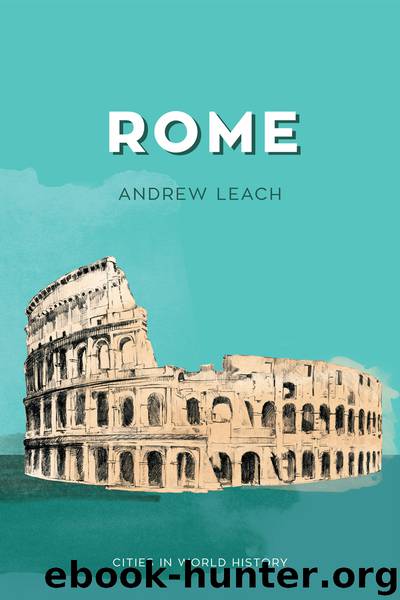
Author:Andrew Leach
Language: eng
Format: epub
ISBN: 9781509514991
Publisher: Wiley
Published: 2016-09-29T00:00:00+00:00
San Clemente
Rome’s path through the thousand years of change initiated by Constantine’s victory over Maxentius is not straightforward; it is complicated by ceaseless negotiations over the true legacy of the Roman Empire and the true nature of its enduring authority over the institutions of the medieval present; it is marked by fundamental transitions in worldview, sweeping rearrangements of the city’s organization, constantly shifting political and military alliances, and, throughout it all, Rome’s position in Christendom. As a city, much of Rome was returned to nature (and the ruin) and agriculture – what in the sixteenth century would be called the disabitato, the uninhabited land within the Aurelian Wall. By the eighth century, its absolute nadir, there were perhaps only three or four people left in the city for every hundred who had lived there in the time of Augustus. And in those built-up areas that remained inhabited, history piled up further: medieval accretions added to monuments of antiquity; temples, warehouses and other buildings from an era safeguarded by Roman gods adapted to the needs of the Church; marble and granite stripped from one building to realize another; towers built, towers destroyed; homes built, homes destroyed; Romans fighting Lombards, Franks, Germans, Normans, Saracens and each other; kingdom versus kingdom on Rome’s behalf; the Church against the city; the Church against the Empire; the Church against itself; the city against the Empire. This rich history adds up to a ceaseless contest between competing images of Rome as a city in (and above) the world, competing bases for its authority and competing legacies, therefore drawing on the lines reaching out from the past and leading towards the future. Every one of these contests was played out through the fabric of the city.
Sitting in an outlying part of the abitato, the Basilica of San Clemente offers a stratified cross-section of this problem that speaks to the slow and steady emersion from antiquity towards the powerful position from which Rome ruled the Christian world in the thirteenth century. Located today on via Labicana between the Colosseum and the Lateran, the Basilica stands as a testament to the triumphant rise of the office of the papacy over that of all other institutions – a moment of clarity emerging from a morass of ambiguities and discordance spanning the ninth to the eleventh centuries. Pope Gregory VII is credited with forcing the issue of papal sovereignty in his conflicts with the Emperor Henry IV. Gregory excommunicated Henry on three occasions; Henry facilitated the removal of Gregory and the installation of an antipope, Clement III (Guibert of Ravenna), having taken Rome in 1083 (a third attempt to assert his control over the city). Gregory held the Castel Sant’Angelo and his allies the Corsi and Pierleoni family held the Capitoline and Tiber Island, respectively, for a time at least. (The tower standing guard over the Ponte Cestio is a document of the Pierleoni occupation of the Island, as is the incongruous house standing opposite San Nicola in Carcere (11) at
Download
This site does not store any files on its server. We only index and link to content provided by other sites. Please contact the content providers to delete copyright contents if any and email us, we'll remove relevant links or contents immediately.
| Africa | Americas |
| Arctic & Antarctica | Asia |
| Australia & Oceania | Europe |
| Middle East | Russia |
| United States | World |
| Ancient Civilizations | Military |
| Historical Study & Educational Resources |
Room 212 by Kate Stewart(5120)
The Crown by Robert Lacey(4814)
Endurance: Shackleton's Incredible Voyage by Alfred Lansing(4782)
The Iron Duke by The Iron Duke(4354)
The Rape of Nanking by Iris Chang(4211)
Joan of Arc by Mary Gordon(4110)
Killing England by Bill O'Reilly(4001)
Say Nothing by Patrick Radden Keefe(3985)
I'll Give You the Sun by Jandy Nelson(3447)
Shadow of Night by Deborah Harkness(3368)
Hitler's Monsters by Eric Kurlander(3342)
Mary, Queen of Scots, and the Murder of Lord Darnley by Alison Weir(3210)
Blood and Sand by Alex Von Tunzelmann(3203)
Eleanor & Park by Rainbow Rowell(3173)
Darkest Hour by Anthony McCarten(3133)
Margaret Thatcher: The Autobiography by Thatcher Margaret(3082)
Book of Life by Deborah Harkness(2939)
Red Famine: Stalin's War on Ukraine by Anne Applebaum(2933)
The One Memory of Flora Banks by Emily Barr(2863)
